Graphs and Formulas
Equations
http://www.uri.edu/artsci/ecn/mead/INT1/ECN201/Equations.pdfEconomics has variety of graphs and formulas and it can be hard to keep track of all of them. The website above provides some of the graphs and formulas that you will encounter in an economics class. This will be useful when you learn about elasticity, normal profit and production possibility curve. These are just some on the topics covered on this site. Equations are integral part of economics and it is better to keep them in one place. And this website does just that.
Foumulas
http://www.econclassroom.com/?page_id=3172Most of the formulas and equations that you will encounter are in the GDP and Inflation chapters. It is better to have all the formulas and equation in one place. This site will give you all the formulas you need to know for these two chapters. This makes it easy to study for the test rather than flipping through your book or notes.
Supply and Demand
http://www.econport.org/content/handbook/Equilibrium/shifts-graph.htmlThis website gives you information on supply and demand. Supply and Demand are to of the most important topics in economics. This site provides you with illustrations of what happens to price and quantity of a good when supply or demand changes. The right understanding of this concept will help you throughout the course.
Market Structure
http://www.amosweb.com/cgi-bin/awb_nav.pl?s=wpd&c=dsp&k=market+structuresThere are 4 types of market structures. This website explains what they are and how much control they have of the market. This website coincides with the graphic image below labeled market structure. It will also explain the barriers to entry, one of the topics covered in the course, for the markets. And illustrate both buyer and sellers sides of the market.
This graph illustrates the relationship between average variable cost, average fix cost, average total cost and marginal costAVC = Total Variable Cost / Quantity Demanded AFC = Total Fix Cost / Quantity Demanded ATC = Total Cost / Quantity Demanded or AVC + AFC MC = Change in Total Cost / Change in Quantity Demanded |  |
Market Structures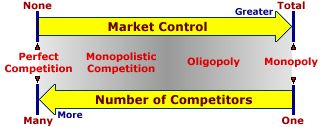 | Supply and Demand Curves |
Simple Circular Flow Model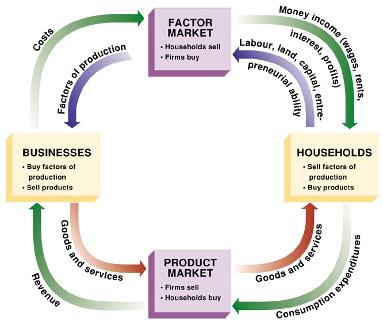 | Circular Flow Model with Leakages and Injections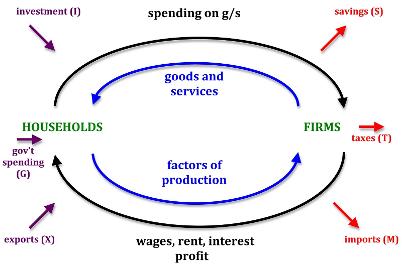 |
An overview of 4 types of Economic Systems

This illustrates the difference between Long-run and Short-run Equilibrium

